
Litchfield County Three-Day Release Window
Litchfield County has no sheriff-operated jail and no official rolling 72-hour release view. The state unified Connecticut county jails and state prisons under the Connecticut Department of Correction. Both accused pretrial people and sentenced people are therefore handled within the state system. A search for local releases must follow the person's correctional facility and court case rather than a county jail name.
The three-day period works as a review frame, not as a filter on an official feed. It gives a researcher time to compare several nightly CT DOC snapshots, watch for a VINE custody change, and inspect court events from Litchfield Judicial District or GA 18 Bantam. It can also catch events that occurred late in the day or before a weekend. None of those sources alone creates a complete list of all Litchfield County releases.
Review Litchfield County 72-Hour Releases
Begin with a date range and identifiers. The three-day method is strongest when the person's full name, date of birth, DOC number, arrest date, or docket number is known. A name-only search can join the wrong CT DOC record to the wrong court case. Each step below checks a different part of the custody trail.
- Search Connecticut VINE for the specific person and note the precise custody status supplied by the participating agency.
- Check the CT DOC Inmate Information Search on more than one day when timing matters. Compare location, status, admission, release-date, bond, and detainer fields.
- Inspect the Connecticut Judicial Branch case lookup for bond, disposition, sentencing, probation, dismissal, or another court event within the period.
- Match the court location. Litchfield Judicial District sits in Torrington, while GA 18 is in Bantam. A county label alone may not identify the right docket.
- Request nonexempt release or movement records from CT DOC Public Information when the online status cannot settle what occurred.
The same-day process is narrower. Use the Litchfield County 24-hour releases check when the question concerns a new event and immediate pickup planning rather than a multi-day review.
Litchfield 72-Hour Release Record Fields
Because no county feed exists, there is no local table of booking numbers, exact release times, reasons, charges, or photos for the last three days. The fields below are the official substitutes. Their meaning depends on which agency maintains them, so preserve the wording and date shown instead of converting every entry into a generic release label.
| Source field | Use in a three-day review |
|---|---|
| DOC name, birth date, inmate number | Confirms that repeated status checks concern the same person. |
| Latest admission and current location | Shows the reported custody period and whether a facility is still listed. |
| Status | Separates accused, sentenced, current-custody, and any release or supervision wording shown. |
| Estimated and maximum release dates | Supplies correctional milestones, not a guaranteed time of departure. |
| Special parole date | May show the point when confinement changes to post-release supervision. |
| Bond and detainer | Explains why a court-ordered or sentence release may be delayed or become a transfer. |
| Docket disposition and events | Identifies bond, time served, dismissal, sentence, probation, or another court basis. |
VINE adds reported custody status and notification information. CT DOC cautions that release dates can change and computer status may not reflect every current fact. The court docket has a different role: it can identify the legal order even if the state custody display has not yet changed. Three consistent sources provide stronger confirmation than one vanished row.
Note: A listed estimated release date is a forecast, while an agency release record documents an event that has already occurred.
Litchfield Weekend Release Record Lag
A 72-hour review can span business days, weekends, or holidays, but the research found no Litchfield rule that batches releases on a set schedule. Do not assume the date range itself proves a weekend discharge. The useful point is that public systems move at different speeds. CT DOC's public search receives a nightly OBIS feed. The accused pretrial and sentenced inmate datasets also update nightly. Court entries may appear on their own docket schedule.
If a release was expected late Friday, check the same CT DOC fields across the next available updates and watch Connecticut VINE for a reported custody change. Then inspect the court docket for bond or disposition. A person may have been ordered released at court, remained temporarily in processing, transferred under a detainer, or left DOC custody after the online snapshot. The wider window allows those distinct events to be sorted without claiming a county list exists.
New Haven Correctional Center is especially relevant because CT DOC says it serves the Bantam and Litchfield courts. York Correctional Institution serves female defendants from every Connecticut superior court. A Litchfield County release can thus occur well outside the county, which makes facility confirmation more useful than assumptions about a local jail door.
Litchfield Current-Data Release Quirk
The main local data quirk is simple: people expect a Litchfield County jail roster, but no county release archive exists. The state's accused pretrial inmate dataset lists people then held in DOC facilities. A separate sentenced inmate dataset lists people serving sentences. Both are current-population sources. Neither preserves a public rolling list labeled “released in the last 72 hours.”
A name disappearing between nightly copies can support further checking. It cannot show whether the person was discharged, bonded out, transferred, moved to a restricted record, or affected by a data mismatch. Connecticut VINE, CT DOC Public Information, and the court docket supply the confirmation layers. This is why a three-day review is an evidence comparison rather than a subtraction exercise.
Note: The state datasets answer who is reported in custody, not who left Litchfield County custody during a fixed rolling window.
Request Litchfield Release Records
When status pages disagree, request the record from the agency that created it. CT DOC Public Information can address nonexempt incarceration dates, facility movement history, release date or type if maintained and public, detainer information, and date fields. A request should include the full name, date of birth, DOC number if known, facility, approximate admission period, and court docket number.
CT DOC lists its Public Information Office at 24 Wolcott Hill Road, Wethersfield, CT 06109. The department publishes 860-692-7480 as a general public-information number and lists offender-information calls at 860-692-7780 during weekday business hours. A requester can ask for a defined three-day custody period, but should not ask the office to create a Litchfield County release list that it does not maintain. A focused request for admission, movement, and release fields is more likely to reach the record that already exists.
A court clerk is the better custodian for a bond order, disposition, sentencing mittimus, probation sentence, or certified docket copy. If release occurred at the police level before DOC admission, the arresting police agency may hold the relevant booking and release-to-court or bond record. Connecticut's Freedom of Information Act permits access to nonexempt public records, while erased, sealed, juvenile, safety-sensitive, and other exempt material may be restricted.
The Division of Criminal Justice criminal-record routing page directs the public toward records held by the State Police, Judicial Branch, and CT DOC rather than supplying criminal records itself.
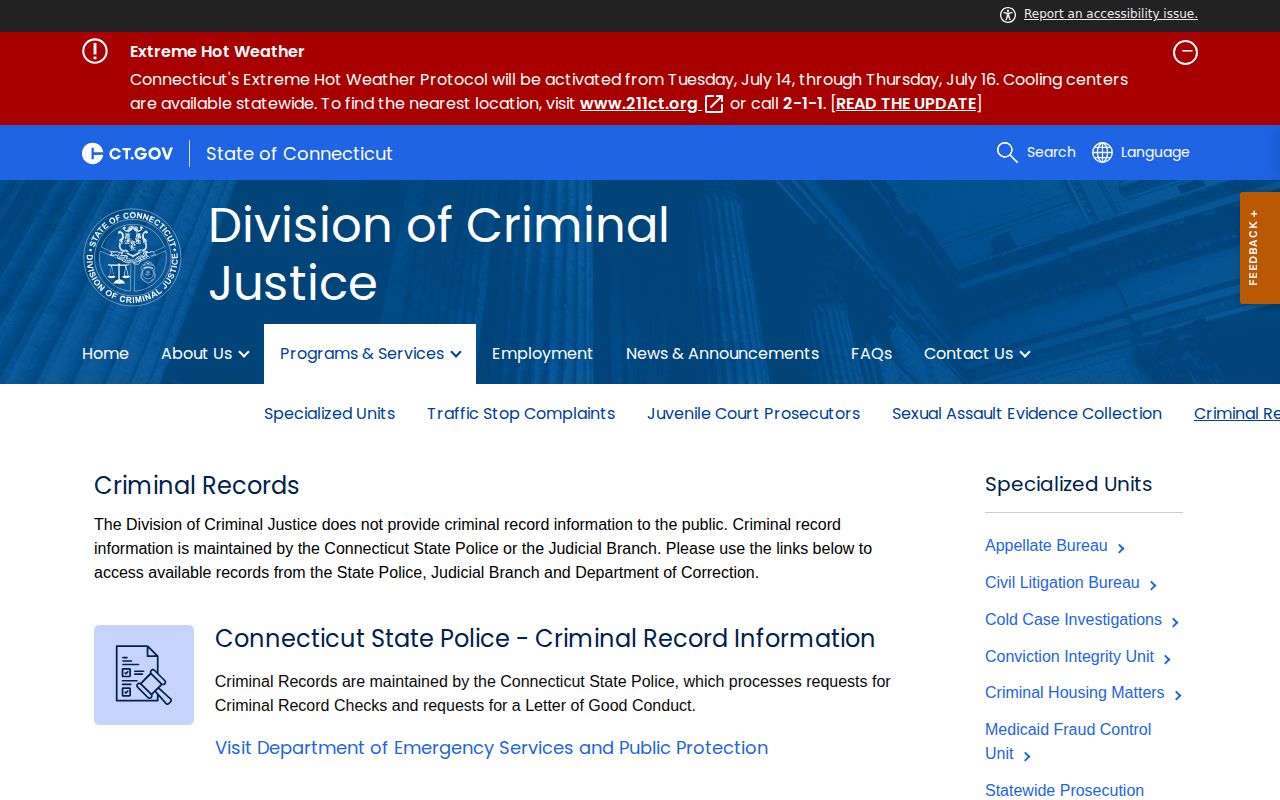
The official routing page helps identify the right custodian after a three-day search reveals a gap. Sending a focused request to the record holder is more reliable than asking an unrelated county office.
Litchfield Release Sources by Custody
A release from CT DOC, a release from court, and a federal release are different events. The state inmate search and DOC Public Information cover Connecticut correctional custody. Judicial Branch dockets explain Litchfield and Bantam court orders. Federal Bureau of Prisons records cover federal sentences, while the U.S. Marshals Service handles federal pretrial custody and transport. ICE maintains a separate current-detainee locator.
| Custody path | Primary confirmation | What release may mean |
|---|---|---|
| CT DOC | DOC status, VINE, Public Information | Discharge, parole, special parole, transfer, bond, or other movement |
| Litchfield or Bantam court | Judicial Branch docket and clerk record | Bond, promise to appear, time served, dismissal, probation, or another order |
| Federal or immigration | BOP, USMS, or ICE source | Federal release, supervised release, or transfer between jurisdictions |
Released from one system does not always mean free from all custody or supervision. A detainer can move someone to another agency. Parole, special parole, or probation can follow physical release. The three-day record should state which system ended custody and what official record supports that conclusion.