
Litchfield Parole Versus Probation
A person can be out of a Connecticut correctional center yet remain under legal control. Parole is community supervision after release from a prison sentence. The Connecticut Board of Pardons and Paroles makes decisions such as granting, denying, rescinding, revoking, or ending parole and special parole. CT DOC Parole and Community Services then supervises people in the community under the authority of the Board or the Commissioner of Correction. Special parole is a court-imposed period that begins after a prison term. It is not the same as an early parole grant.
Probation belongs to the Connecticut Judicial Branch Court Support Services Division. A Litchfield Judicial District case can result in probation without a prison term, or in a split sentence that combines confinement with probation. The court docket is therefore the first record to read. It may identify the sentence, suspended time, probation term, conditional discharge, or a later violation event. The Litchfield Judicial District adult probation route is local to Torrington and Bantam, while parole is managed through statewide DOC and Board offices.
| Point | Parole or Special Parole | Probation |
|---|---|---|
| Source | Prison release or court-ordered special parole | Sentence entered by the court |
| Decision record | Board decision, DOC status, or parole file | Court docket and sentencing record |
| Supervising system | CT DOC Parole and Community Services | Judicial Branch adult probation |
| Local verification | DOC record, Board resources, then district routing | Litchfield court record, then adult probation office |
| End point | Discharge from parole jurisdiction | Completion, court termination, or other court action |
- Parole
- Supervised community release during a prison sentence.
- Probation
- Court-ordered supervision that may follow or replace confinement.
- Discharge
- The formal end of custody or supervision authority.
- Absconder
- A supervised person alleged to have stopped reporting or left supervision without permission.
Verify Litchfield Post-Release Supervision
Begin with the legal event that placed the person under supervision. For someone released from New Haven Correctional Center, York Correctional Institution, or another Connecticut facility, use the CT DOC Inmate Information Search. Read status, estimated or maximum release date, special parole date, location, and detainer fields together. A release date by itself does not say whether parole, special parole, or another form of control began that day.
For probation, search the Connecticut Judicial Branch criminal case lookup by name or docket. Match the Litchfield Judicial District, Torrington, or GA 18 Bantam court setting. The sentence and later docket events are more useful than a current-custody roster because probation may begin without any DOC admission. A released-person search on the Litchfield County release records home page explains how the court and DOC records fit together.
- Identify whether the person served DOC confinement, received probation in court, or had both parts in a split sentence.
- For DOC confinement, compare inmate number, birth date, admission date, status, and special parole date in the statewide search.
- Check Board resources when the issue is a parole hearing, grant, denial, rescission, revocation, or discharge.
- Read the Litchfield or Bantam court docket for a probation sentence, violation filing, warrant event, or changed court order.
- Contact the correct supervision office only after the record identifies parole or probation. Ask for routing, not private case details.
Litchfield Supervision Office Records
Litchfield County does not have a county parole board. The statewide CT DOC Parole and Community Services division assigns district supervision and operates specialized units. The Hartford office is one documented western and central Connecticut contact, but some cases may route through Waterbury or another district. Confirm the assignment with DOC rather than using county lines as a guess.
Probation routing is different. The Litchfield Judicial District adult probation contact serves court supervision matters. A directory address at 50 Field Street and a separate Judicial Branch office listing at 30 Peck Road both appear in the research sources, so call before traveling and ask which location holds the case. The docket number helps staff identify the right court and supervision unit.
CT DOC Parole and Community Services
Central Office
24 Wolcott Hill Road
Wethersfield, CT 06109
Phone: (860) 692-6901
Hartford District
300 Sheldon Street
Hartford, CT 06106
Phone: (860) 297-4400
Litchfield JD Adult Probation
50 Field Street
Torrington, CT
Phone: 860-626-2371
Hours: Monday through Friday, 9 a.m. to 5 p.m.
Note: Office routing may change, so verify the assigned district and appointment site before relying on a directory address.
Litchfield Parole Hearing Records
The Connecticut Board of Pardons and Paroles publishes a statewide parole hearing schedule and points to the public meeting calendar. A listed hearing is not a grant. Outcomes can include a grant, denial, continuance, rescission, revocation, early termination review, discharge, or a special parole action. Verify the result through an official decision or a Board record request.
The hearing page says sessions generally start at the posted time and that schedules may be updated. It also bars recording or screen capture of livestreamed proceedings under Connecticut law. Members of the public may request an official hearing copy through the Board's Freedom of Information channel. This distinction matters: the schedule shows that a matter is set, while the decision record shows what the panel did.
The Board of Pardons and Paroles is located at 55 West Main Street, Suite 520, Waterbury, CT 06702, and lists 203-805-6605. For a Litchfield County case, use the person's DOC number and hearing date when seeking a decision. Never infer supervision status merely because a video or calendar entry exists.
The official Board home page shows the statewide agency used for Litchfield parole matters.
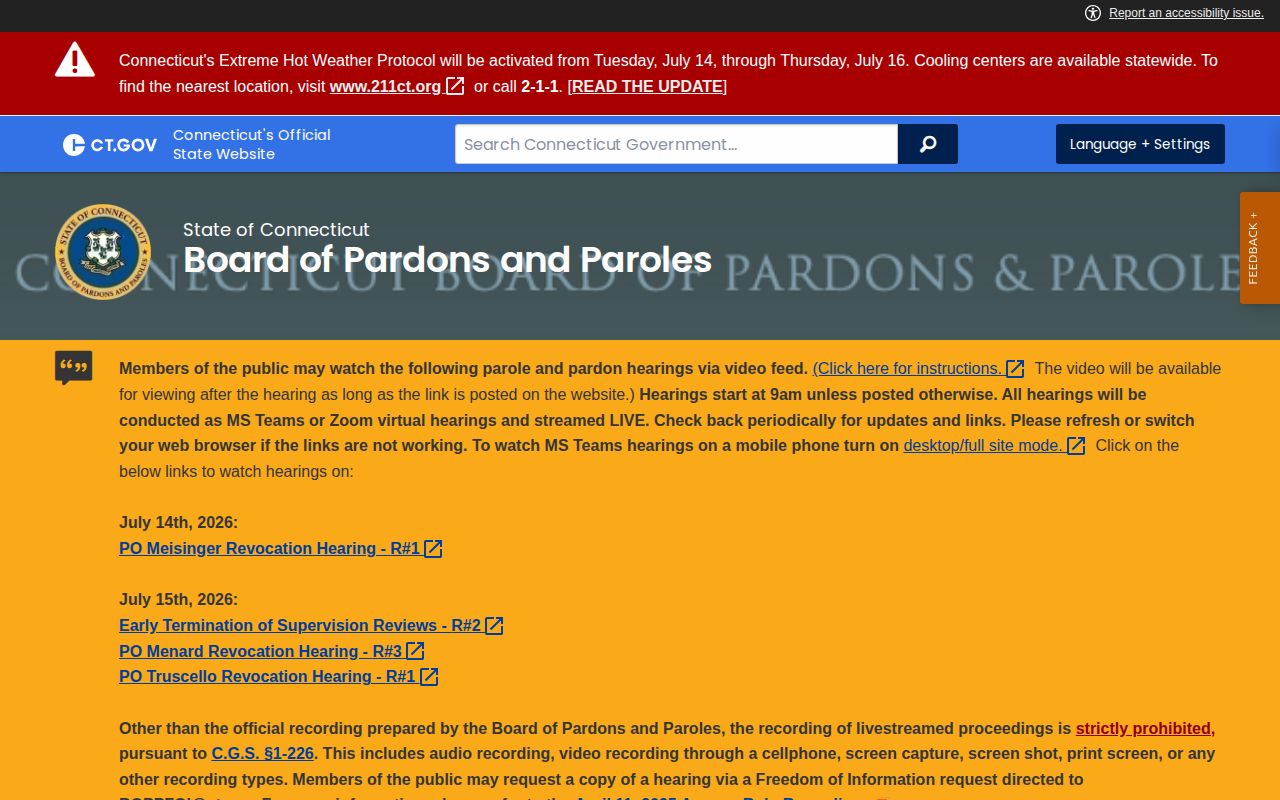
The image helps identify the correct state source, but a dated Board decision remains the key proof of a parole outcome.
Litchfield Reentry Supervision Network
Post-release services for Litchfield County are not organized as a county jail reentry office. CT DOC Parole and Community Services uses district offices and statewide specialist units. Its published structure includes Residential Services, Central Intake, Mental Health, Fugitive Investigations, DUI, Women's Re-Entry, Support Services, and Training. The correct unit depends on the release authority and supervision plan, not just the town where the person intends to live.
Residential placement or a halfway-house move may appear to a family as a release, but it can remain part of DOC control. Likewise, a person can leave a correctional center for special parole and still have strict reporting terms. Confirm the status label and assigned office before assuming the sentence has ended. If the court instead ordered probation, adult probation remains the right channel even when the person previously spent time in DOC custody.
Supervision usually ends through a formal event. The Board may discharge a person from parole jurisdiction or terminate special parole where authorized. Probation ends under the sentence and court process. A maximum release date, an estimated release date, and the end of supervision can therefore be three different dates.
Litchfield Absconder and Violation Checks
No public Litchfield County parole absconder list was found. For an alleged parole absconder, CT DOC Parole and Community Services lists a Fugitive Investigations Unit at (203) 346-7830. An absconder claim means the person is alleged to have broken contact with supervision. It is not the same as proof of a new conviction, and it should be checked with the responsible agency.
A probation violation follows a court path. Search the Litchfield or Bantam docket for a violation-of-probation event, a failure-to-appear entry, a warrant, or a changed order. For parole, check DOC status, Board action, and the supervising unit. VINE may report a later custody change if a participating agency takes the person back into custody, but VINE is not a supervision case file.
Conditions vary by order and case. At a high level, supervision may require reports, approved residence or travel, treatment, programs, or compliance with court and agency directions. Only the signed order or supervision record establishes the actual terms. A missed appointment alone should not be turned into a public claim that someone is a fugitive.
Note: A warrant entry, Board action, and VINE alert answer different questions and should be reconciled before drawing a conclusion.
IDs After Litchfield County Release
Connecticut has a useful property detail for people discharged from DOC. The Offender Re-Entry Services information says identification held at a facility remains there until discharge. If it is not claimed, the identification stays at the discharging facility for 30 days. It is then sent to DOC Central Office in Wethersfield and may be stored for up to two years after discharge.
This is separate from proving parole or probation status, yet it often matters right after release. Start with the facility that discharged the person and provide the DOC number and discharge details. If the stated holding period has passed, contact DOC Central Office. Do not assume a Litchfield court or adult probation office holds property that remained with the correctional facility.
The property trail also helps distinguish the agencies involved. New Haven Correctional Center or York Correctional Institution may hold DOC property, while a Torrington or Bantam court record explains the order that led to release. The probation office supervises a court sentence; it is not the records custodian for DOC identification.