
Litchfield Projected Release Dates
Connecticut DOC uses several date fields, and each answers a different question. The estimated release date is the closest official match for what many people call a projected or tentative release date. A minimum release date may mark a threshold within the sentence. A maximum release date reflects the outer date shown in the correction record. A special parole date can mark the shift from confinement to a court-imposed period of community supervision. None should be read alone.
The actual release date is the day custody changes. It may match the estimate, but later credit decisions, discipline, court action, or another agency's hold can alter the outcome. CT.gov cautions that release dates are subject to change and that not all status changes are processed at once. Connecticut's public inmate data is fed nightly from the Offender Based Information System, so a new event can occur before the public screen reflects it.
Pretrial custody works differently. Someone held at New Haven Correctional Center on a Litchfield or Bantam case has not yet received a final prison sentence. The next release event may depend on posting bond, a promise to appear, a changed bond order, dismissal, or a later sentence. In that setting, the court docket is often more useful than a projected-date field.
- Estimated release date
- The current DOC calculation of when confinement may end, subject to later legal and record changes.
- Actual release date
- The date the holding agency reports that its custody ended or changed to another status.
- Detainer
- A notice that another agency claims custody, which can turn a state release into an agency transfer.
- Special parole
- A court-imposed period of community supervision that begins after the prison portion of a sentence.
These labels should remain separate in notes and records requests. Combining them into one date can hide the difference between eligibility, an estimate, a transfer, and an actual departure from DOC confinement. When two sources disagree, record when each source was checked and ask the agency that owns the disputed field.
Lookup Litchfield Release Date Records
The CT DOC Inmate Information Search is the primary statewide lookup when a person entered Connecticut correctional custody. New Haven Correctional Center serves the Bantam and Litchfield courts for relevant male pretrial cases, and York Correctional Institution receives female offenders from all Connecticut superior courts. A sentenced man may be held at any suitable DOC facility. The court county and facility county do not have to match.
Search with a DOC number when possible. If only a name is known, compare date of birth, latest admission date, current location, controlling offense, sentence date, and court context before relying on a match. The public fields documented by DOC include minimum, maximum, and estimated release dates; maximum sentence; special parole date; bond amount; and detainer information. The Litchfield County released-person search provides the broader path when no DOC match remains.
- Gather the full legal name, date of birth, DOC number, docket number, and approximate admission date.
- Search by DOC number first. For a name search, match more than one identifier and account for aliases or spelling differences.
- Read status and current location before the date fields. A current facility means DOC release has not been confirmed.
- Record the estimated, maximum, minimum, and special parole dates exactly as labeled. Check for a detainer.
- Open the Litchfield Judicial District or GA 18 Bantam docket to compare the sentence, jail credit, bond, and later orders.
- Ask DOC Public Information for nonexempt movement or release information when the public record is absent, delayed, or unclear.
Note: Disappearance from a current-custody result may mean release, transfer, restricted data, or another change and is not proof by itself.
Litchfield Release Date Fields
Read the inmate record as a set of related facts. The dates shown by CT DOC sit beside status, sentence, facility, offense, and detainer data. A reliable match starts with identity and admission details. It then asks whether the person is accused or sentenced, whether the location is current, and whether the sentence record contains a release calculation.
| Field | What It Can Show |
|---|---|
| Estimated release date | The main CT DOC projected-date label, subject to later change |
| Minimum release date | A sentence threshold shown when applicable |
| Maximum release date | The outer release date currently calculated in the record |
| Special parole date | A possible transition from prison confinement to special parole |
| Sentence date and maximum sentence | The court-imposed basis for the calculation |
| Bond amount | A pretrial release condition rather than a sentenced release estimate |
| Detainer | A hold that may lead to transfer instead of community release |
| Status and location | Whether the public record still identifies current DOC custody |
The DOC Management Information Systems Unit describes OBIS as tracking a person from intake through eventual release and feeding the public search nightly. That cadence explains why an exact court event and the public correction screen may briefly differ.
Litchfield Earned Credit Rules
Connecticut calls its main sentence-credit program Risk Reduction Earned Credit. Under C.G.S. § 18-98e, an eligible sentenced person may earn credit through an offender accountability plan, approved programs or activities, and good conduct. Good conduct alone does not create an automatic right to credit. The Commissioner or a designee can remove some or all credit for misconduct, insubordination, refusing programs or rules, or other good cause.
Eligibility is not universal. The law excludes listed serious offenses and certain persistent dangerous offenders. Earned credit also cannot reduce a mandatory minimum term that another statute requires. That is why a simple “sentence minus good time” estimate can be wrong. The sentence, offense category, mandatory term, risk level, program participation, and credit history all matter.
The official CT DOC Risk Reduction Earned Credit explanation shows the state policy used in release-date calculations.
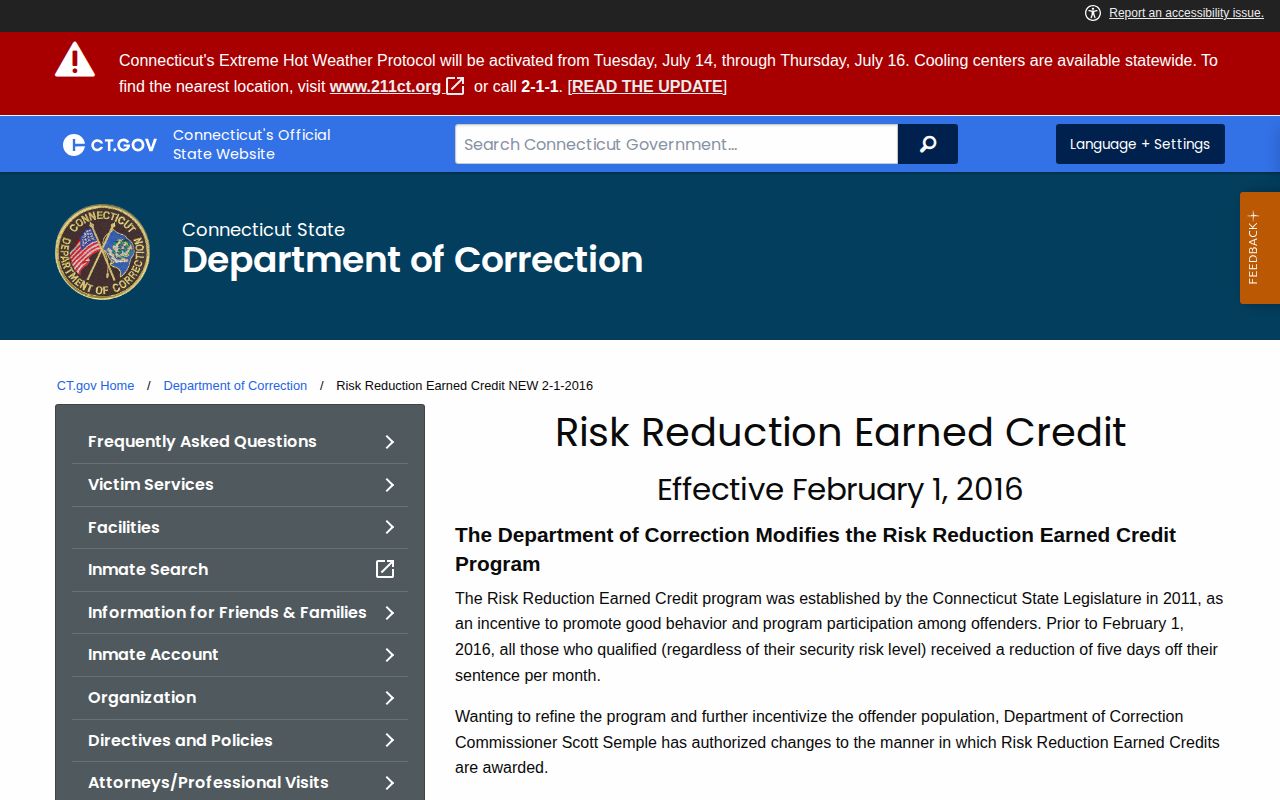
The source ties monthly credit to risk level, program participation, and conduct, which helps explain why two similar sentence lengths may produce different estimates.
How Connecticut Computes Litchfield Releases
This Connecticut-specific calculation is the page's distinctive release-date issue. DOC policy describes a structure in effect since February 1, 2016. Level 1 and community-supervision classifications can earn five days per month, Levels 2 and 3 can earn four, and Level 4 can earn three. Level 5 is the highest risk level and earns the least under the structure. These are earned credits, not automatic calendar deductions.
Parole eligibility adds another layer. C.G.S. § 54-125a provides a general eligibility route for many people serving more than two years after one-half of the qualifying sentence, less eligible risk reduction credit. The same statute excludes certain offenses from that route and requires people convicted of covered violent or force-based offenses to serve at least 85 percent of the definite sentence before eligibility under the relevant subsection.
Eligibility is not release. The Board must still make a suitability decision where parole applies. A grant may move the person into parole supervision before the maximum date. A denial can leave the confinement calculation in place. Special parole is different again because it is imposed by the court and begins after prison.
Litchfield County has no sheriff-operated good-time system. Connecticut unified county jail and prison functions under DOC. A short sentence tied to a Litchfield case is computed through the court mittimus, presentence credit, Connecticut law, and DOC records. A mittimus is the court document that directs custody under the sentence. If release happens at court on bond or time served before DOC admission, the court order controls instead of a DOC estimate.
Why Litchfield Release Dates Change
A projected date changes when one or more inputs change. Some changes move the date earlier, while others move it later or change release into a transfer. The reason should be checked in the system that created it. DOC maintains credit, custody, and movement information; the court controls the sentence and later orders; the Board controls parole decisions; and another agency may control a detainer.
| Factor | Possible Effect | Best Record |
|---|---|---|
| Earned credit | May reduce an eligible sentence calculation | DOC sentence and credit record |
| Credit loss | May move an estimated date later | DOC disciplinary and sentence record |
| Presentence confinement credit | Can count qualifying time already held | Court mittimus and DOC calculation |
| Mandatory minimum | Sets time that earned credit cannot reduce | Statute and sentencing record |
| Parole decision | Can allow supervised release or leave confinement in place | Board decision |
| Detainer or warrant | Can cause transfer to another authority | DOC field and holding agency record |
| Modified or added sentence | Can recalculate the controlling date | Court docket and DOC record |
A detainer deserves special care. It is a notice that another agency claims custody or has a hold. Reaching the Connecticut release date may lead to pickup by that agency rather than release to the community. “Released from CT DOC” and “free from all custody” are not interchangeable.
Note: Record each date with its label and source because an estimated date, parole eligibility date, and special parole date are not substitutes.
Confirm Litchfield Actual Release Dates
Close the lookup with a status check, not the estimate alone. Connecticut VINE can send a notice when a participating custody source reports release, transfer, or another status change. The Litchfield County VINE inmate check explains how to match one person and register an alert. VINE does not state every legal reason behind the event, so compare the alert with DOC and the court docket.
When the public search is unclear, contact the Connecticut Department of Correction Public Information Office. The published address is 24 Wolcott Hill Road, Wethersfield, CT 06109. The DOC home page lists 860-692-7480, while the inmate information route lists (860) 692-7780 for offender-information requests from 8:00 a.m. to 4:30 p.m. on weekdays. Ask for nonexempt admission, movement, sentence-date, detainer, release-date, and release-type information.
If the person was released in court, use the Litchfield Judicial District clerk at 50 Field Street in Torrington or the GA 18 clerk at 80 Doyle Road in Bantam, depending on the docket. Bond, time served, dismissal, a nolle, probation, or a modified order can explain a release that never produced a fixed DOC date. A nolle means the prosecutor chose not to pursue the charge at that time.