
Litchfield Courthouse Release Records
The Litchfield Judicial District Superior Court in Torrington and Geographical Area No. 18 in Bantam have short-term courthouse holding handled by Judicial Marshals. A person can be held for arraignment, a bond hearing, transport, sentencing, or another appearance. Neither location is an active county jail. Neither publishes a booking roster or rolling recent-release list.
The court docket and order are the main release record when practical release happens at court. Those documents can show a bond, nonfinancial conditions, time served, dismissal, nolle, probation, or another disposition. When the judge remands or sentences a person to confinement, CT DOC becomes the custody system. The release search then moves from the courthouse to the statewide DOC record.
| Court event | What follows | Best record |
|---|---|---|
| Bond posted | Release while the case continues | Docket and bond order |
| Promise to appear | Noncustodial case status | Release conditions and docket |
| Time served | Sentence may end at court | Judgment and mittimus |
| Probation sentence | Judicial supervision outside custody | Docket and Adult Probation Services |
| Remand to DOC | Transfer into state correctional custody | Court order, CT DOC search, and VINE |
Confirm Litchfield Courthouse Releases
Begin with the Connecticut Judicial Branch Criminal and Motor Vehicle Case Look-up. Search the correct person and compare the docket number, court location, charges, and dates. A name alone can match the wrong case. The court entry may explain why the defendant left holding even when CT DOC has no admission record.
- Gather the full name, birth date, arresting agency, docket number, and scheduled court location.
- Search the Judicial Branch docket and read the latest bond, disposition, and sentence entries.
- Contact the Torrington or Bantam clerk for a public order, docket sheet, mittimus, or certified copy not available online.
- Search CT DOC and VINE only if the court remanded the person or the record suggests a DOC admission.
- Ask the arresting police agency for its release-to-court, bond, or booking material when the person never entered DOC.
The Connecticut Division of Criminal Justice does not give public criminal records to requesters. Its published routing points to the Judicial Branch, State Police, and CT DOC. The prosecutor's office is therefore not the first place to look for a routine release status or public docket.
Note: Use the docket number and court location together because a name alone can match the wrong case.
Litchfield and Bantam Release Courts
Local court geography causes common search errors. The Litchfield Judicial District court is at 50 Field Street in Torrington, not in the town of Litchfield. GA 18 is at 80 Doyle Road in Bantam. A person described only as having a “Litchfield County case” may have records tied to either court context.
50 Field Street
Torrington, CT 06790
Main phone: (860) 626-2100
80 Doyle Road
Bantam, CT 06750
Clerk phone: (860) 567-3942
Use the court directory to confirm current counter instructions and which clerk holds the docket. A clerk can explain how to request an available court record, but should not be asked to interpret the legal effect of an order. For legal meaning, consult counsel or rely on the written order and applicable law.
Note: Confirm the correct courthouse before requesting copies or traveling to a clerk's counter.
Litchfield Courthouse DOC Transfers
A remanded male defendant may go into CT DOC custody through a correctional center serving the court. New Haven Correctional Center expressly serves the Bantam and Litchfield courts. York Correctional Institution serves female defendants from all Connecticut superior courts. Sentenced men can later move to another institution based on DOC placement.
Search CT DOC by inmate number when possible. Otherwise match name, birth date, latest admission, status, location, controlling offense, and court information. A current location shows where DOC reports the person in custody. Estimated, maximum, and special parole dates concern projected movement or supervision. They do not replace the court order.
Connecticut VINE can provide a participating custody update or notification. It is valuable when a defendant has moved from court into DOC, but it is not a Litchfield courthouse roster. If the person has no VINE result, check for a name mismatch, an agency that does not participate in the expected stream, restricted data, federal custody, or no DOC admission.
Note: Court release and DOC release are separate events that may appear in different systems.
Request Litchfield Court Release Records
Ask the office that created the document. The clerk holds the court docket, release order, bond record, disposition, and public sentencing papers. CT DOC Public Information holds nonexempt DOC admission, movement, release, sentence-date, detainer, and photograph information. The arresting police department or State Police troop holds its own arrest and booking material.
A focused request should name the person, date of birth, docket, court, approximate arrest or hearing date, and exact record sought. For example, request the nonexempt docket sheet and order showing the custody disposition on a stated date. If the person entered DOC, request admission and movement dates for that custody period. Broad requests can take longer to identify and may sweep in restricted information.
Connecticut's Freedom of Information Act governs access to public agency records subject to exemptions. Section 1-200 defines public records broadly, section 1-210 establishes access and exemptions, and section 1-212 addresses copies. State-agency paper fees commonly may not exceed 25 cents per page, while other public agencies commonly may charge up to 50 cents per page under the statutory framework. Special formats, certification, and applicable waivers can differ, so request an estimate.
Litchfield Court Release Status
Released from courthouse holding and released from all custody are not the same statement. Judicial Marshals may transfer a remanded person to CT DOC. DOC may later transfer that person to another institution. A detainer may send the person to federal, immigration, or another jurisdiction's custody. Each movement can remove the person from one place while custody continues elsewhere.
| Status clue | What it establishes | What remains to check |
|---|---|---|
| Court order allows release | Legal authority for release from that case | Other holds or cases |
| DOC current location | Reported state custody | Projected dates and court basis |
| VINE change alert | Reporting agency changed the custody status | Order, destination, or supervision |
| Probation sentence | Community supervision was ordered | Adult probation routing |
| No online result | No positive conclusion | Clerk, police, and DOC records |
Parole and special parole belong to the Board of Pardons and Paroles and CT DOC Parole and Community Services. Probation belongs to the Judicial Branch Court Support Services Division. A court release can therefore begin another form of supervision rather than end the case.
Note: A release order does not cancel a valid hold or supervision term from another case.
Litchfield Probation After Release
A probation sentence can follow a court release without any parole decision. The docket should establish that probation was imposed. Litchfield Judicial District Adult Probation Services is then the local routing point. The 211 Connecticut listing gives 50 Field Street in Torrington, phone 860-626-2371, and weekday hours of 9 a.m. to 5 p.m. Judicial Branch materials also list an adult probation office at 30 Peck Road in Torrington.
Do not ask the Board of Pardons and Paroles to confirm ordinary probation. Likewise, do not treat a DOC special parole date as probation. The Litchfield County post-release supervision record separates these agencies and explains how to verify the sentence before calling an office.
- Probation
- Court-ordered community supervision handled by the Judicial Branch.
- Parole
- Conditional release from confinement under the state parole system.
- Remand
- A court direction placing a person into custody.
- Discharge
- The end of a stated custody or supervision obligation.
Litchfield Courthouse Record Source
The official Litchfield Judicial District directory identifies the Torrington court and its public contact path.
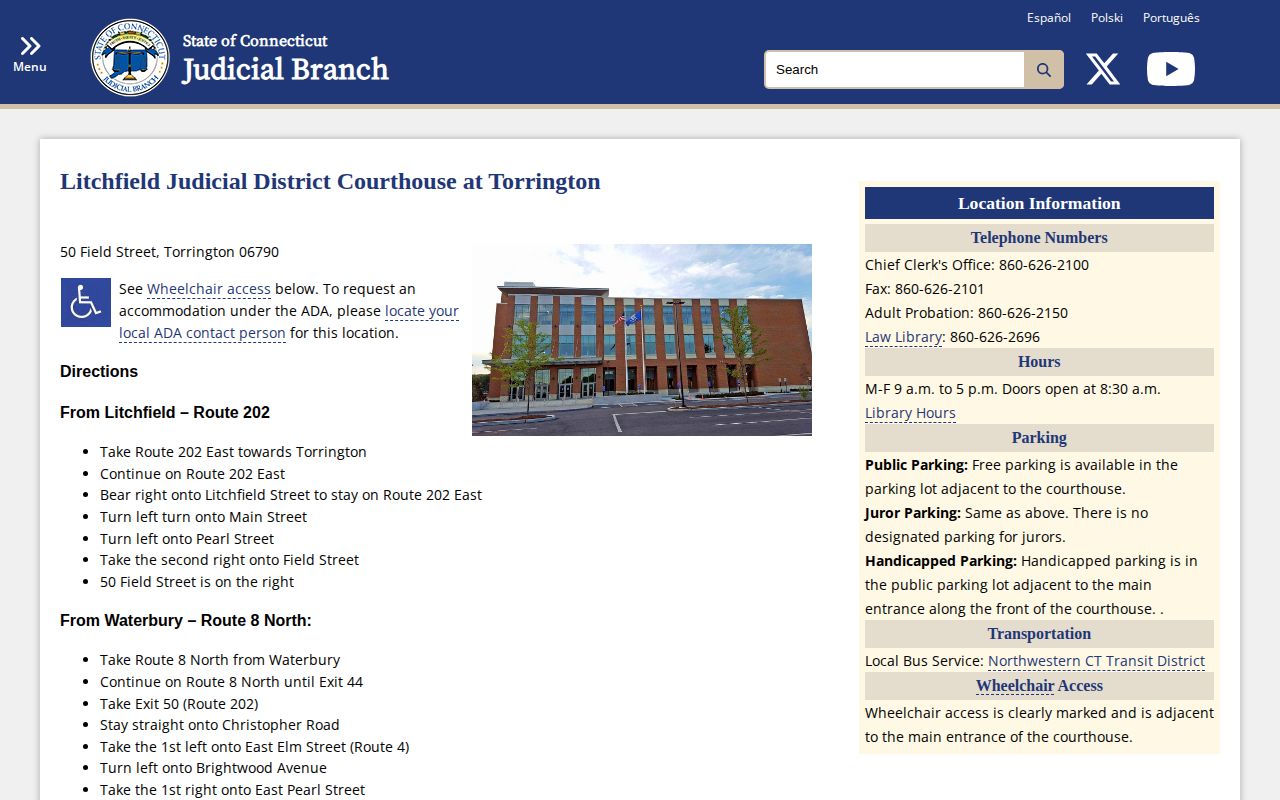
The directory image anchors the search to the court that creates the docket and orders. It is not a live view of courthouse custody and does not identify people held or released.
Historic Litchfield Jail Warning
The former Litchfield County Jail is closed. It is a historical site, not a modern custody office, and it has no current release list. Search results or local references to the old jail can misdirect someone away from the Torrington and Bantam courts and the statewide DOC system.
Connecticut unified county jails and state prisons under CT DOC in 1968. Modern records therefore follow the court, Judicial Marshals, DOC, VINE, and the arresting agency. The Litchfield County released inmates search maps those systems without treating the historic building as an active facility.
Older addresses and building names should be checked against the current Judicial Branch directory before a visit or records request. A historical reference can supply context, but only the present clerk, DOC custodian, or arresting agency can identify the active record holder.
Public Record Search
Sponsored Results