
Litchfield County Release System
There is no active Litchfield County jail run by a county sheriff. Connecticut placed its former county jails and state prisons under one Department of Correction in 1968. The Connecticut Department of Correction now holds both accused people awaiting trial and people serving sentences. That structure changes the search. A person tied to a Litchfield County case may be held at New Haven Correctional Center, York Correctional Institution, or another CT DOC facility far from the county line.
“Released” can describe several different events. Bond or a promise to appear may return a person to the community while a case continues. A court may dismiss or nolle a charge, order time served, impose probation, or remand the person to DOC. A sentenced person may complete confinement, begin parole or special parole, or move to another agency on a detainer. A transfer is not a community release. The agency and the legal basis must be checked before treating a missing custody result as proof that all custody ended.
Litchfield County Release Types
The release path determines which record survives after custody. Connecticut court records are especially important when release happens before DOC admission. DOC records carry the stronger movement trail when the person entered a correctional center. These common outcomes should not be merged into one “out of jail” label.
| Release event | What it means | Best next record |
|---|---|---|
| Bond or nonfinancial release | The criminal case continues outside custody. | Judicial Branch docket and bond order |
| Time served | The court credits confinement toward the sentence. | Sentence, mittimus, and DOC movement record |
| Dismissal or nolle | The pending charge ends or is not prosecuted at that point. | Court disposition |
| Parole or special parole | Confinement ends while legal supervision continues. | CT DOC and Board of Pardons and Paroles records |
| Probation | Judicial Branch supervision follows a court sentence. | Court docket and Adult Probation Services |
| Detainer transfer | CT DOC custody ends but another agency takes custody. | DOC detainer and receiving-agency record |
- Discharge
- The end of a stated custody or supervision term.
- Time served
- A sentence satisfied in whole or part by time already held.
- Detainer
- A request or hold from another authority that can block community release.
- Special parole
- A court-imposed supervision term that begins after prison release.
Litchfield County Release Record Fields
A single public page may not display a finished “release certificate.” Instead, the release record is assembled from DOC identity, sentence, date, status, movement, and court fields. The CT DOC Offender Based Information System follows a person from intake through eventual release and sends a nightly feed to the public inmate search. Court records explain bond, disposition, and sentence events that DOC data alone may not show.
| Field | What it shows |
|---|---|
| Inmate number and name | The DOC identity used to avoid a name-only mismatch |
| Latest admission date | The start of the most recent DOC custody period |
| Status and location | Whether the record reflects accused, sentenced, facility, or other custody context |
| Estimated release date | DOC's current projected date, which may change |
| Maximum release date | The outer date shown in the sentence calculation |
| Special parole date | The expected shift from prison into special parole when applicable |
| Bond and controlling offense | Key case and release context while the person remains accused |
| Detainer | A possible transfer or hold by another authority |
| Court disposition | Bond, dismissal, sentence, probation, or other legal basis |
A released person may no longer appear in a current-only result. That absence does not erase the agency's retained record. It means the search should shift from the live lookup to DOC Public Information, the Judicial Branch docket, and the agency that made the arrest. Sealed, erased, juvenile, medical, victim, safety, and law-enforcement-sensitive details can remain restricted.
Request Litchfield County Release Records
The Connecticut DOC Public Information Office is the main request point for DOC custody and movement. A narrow request is easier to identify and review than a broad demand for every file. Include enough facts to separate people with similar names, but ask only for the custody period and fields that matter.
- Gather the full name, date of birth, DOC number if known, court docket, approximate admission date, and likely facility.
- Search the Judicial Branch criminal and motor vehicle docket first for the court outcome and location.
- Ask DOC Public Information for nonexempt admission, movement, release, sentence-date, detainer, and photograph fields maintained for that custody period.
- Ask the Torrington or Bantam clerk for a docket sheet, public bond or release order, disposition, sentencing mittimus, or certified copy when the court created the needed record.
- For an arrest photo or local arrest record, contact the arresting police department or Connecticut State Police troop that created it.
24 Wolcott Hill Road
Wethersfield, CT 06109
Offender information: (860) 692-7780
Monday-Friday, 8:00 a.m.-4:30 p.m.
DOC.PIO@ct.gov
The Connecticut Freedom of Information Act broadly covers recorded public-agency business, subject to exemptions. Sections 1-200 and 1-210 define the records and access rule. Section 1-212 governs copies and fees. State-agency paper copies commonly may cost up to 25 cents per page under the statute, though other formats, programming, certification, or a particular request may be handled differently. Ask the custodian for an estimate instead of assuming a flat release-record fee.
Litchfield Release Records After Erasure
Public visibility can change without proving that the earlier custody never occurred. Connecticut Clean Slate provides automatic erasure for some eligible convictions imposed on or after January 1, 2000. Eligible older convictions may require a petition. A sealed case, erased record, juvenile matter, or statutory exemption can remove details from public view. The safe response to a gap is to ask the court or agency custodian whether access is restricted, not to guess at the reason.
Retention also varies by record system. The research found no Litchfield County release-feed retention rule because there is no county feed. DOC retains its own offender and movement records, while a court controls its docket and order copies. Police agencies control the arrest material they made. Each custodian applies the FOI Act, applicable retention schedule, and confidentiality rules to its own record.
Litchfield Inmate Costs After Release
Connecticut DOC notes that state law may require an offender to reimburse taxpayers for a correctional stay. The Department of Administrative Services Collections Recovery Unit assesses covered costs and collects money from specified sources. This is a state reimbursement issue. It is not a Litchfield County booking fee, a local jail gate charge, or a fee that must be paid before every release.
Record-copy costs are separate. A fee for paper copies or special production does not alter a release status. Likewise, an unpaid reimbursement claim should not be read into a public custody result unless an official record says it affected the case. Keep custody, court debt, and public-record copy fees in their own lanes.
Find Litchfield County Released Inmates
Start with the system most likely to have held the person, then confirm the legal reason for leaving. Litchfield County has no recent-release roster, so a good search uses several records in a set order. Save exact status terms and dates. Do not rely on a screenshot or a common name alone.
- Search CT DOC by inmate number when available, or match a name against date of birth, admission, facility, offense, and court details.
- Check Connecticut VINE for a participating custody status change or an alert tied to the matched person.
- Search the Torrington or Bantam court docket for bond, time served, dismissal, sentence, or probation.
- Check parole or probation only when the sentence or DOC status points to supervision.
- Use BOP, ICE, or U.S. Marshals sources only when the case indicates federal or immigration custody.
- Request the DOC, court, or police record when online sources do not settle the event.
For a same-day view, the Litchfield County 24-hour release record path begins with the same absence of a county feed and the same need to verify a recent change. A named-person search still requires the full chain above.
Note: Match the same person across systems before treating any status change as a release confirmation.
CT DOC Litchfield Release Search
The CT DOC Inmate Information Search is the central public lookup for anyone admitted to Connecticut correctional custody. Search by DOC number if possible. With a name search, compare every available identifier. A current facility confirms a custody location according to the latest data; it does not confirm release.
| Search field | How to use it |
|---|---|
| DOC number | Best match key when known |
| Name and date of birth | Use together to avoid common-name errors |
| Latest admission | Match the expected custody period |
| Status and location | Separate current facility custody from another status |
| Estimated, maximum, and special parole dates | Read each label exactly; none is a promise of the actual exit time |
| Detainer | Check for a transfer or other hold |
The official search form can be reviewed through the CT DOC inmate information source.
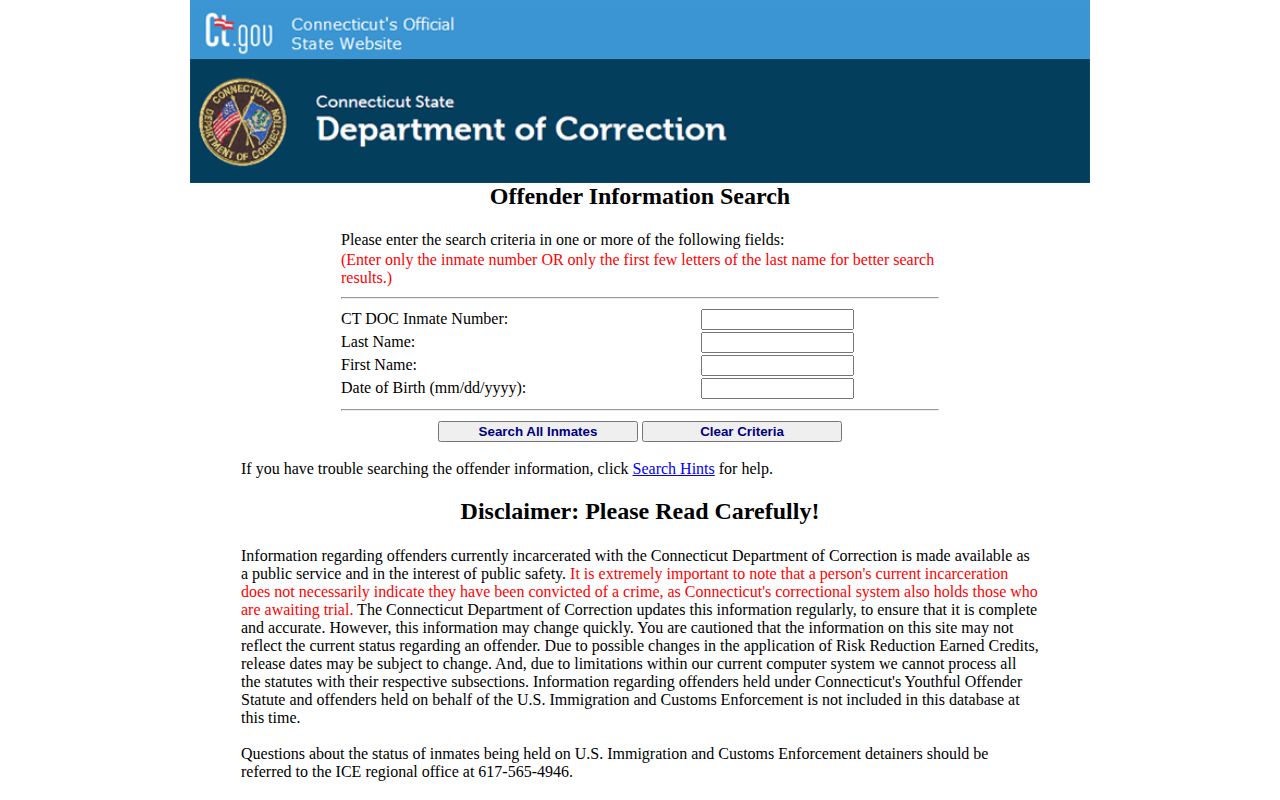
The form illustrates why a DOC number and matching identity fields are stronger than a name-only result. CT DOC warns that dates may change and not every status is processed at once.
Litchfield Court Release Records
Court interplay carries unusual weight here. The Litchfield Judicial District Superior Court sits in Torrington, while Geographical Area No. 18 is in Bantam. A person may leave court on bond, a promise to appear, time served, dismissal, a nolle, or a probation sentence before a clear DOC release detail appears. Search by the actual docket and court, not by county name alone.
The Connecticut Division of Criminal Justice does not supply public criminal records and routes requests to the State Police, Judicial Branch, and DOC. That means the prosecutor is not the first public release lookup. Use the criminal case docket for the order and disposition, the convictions lookup when relevant, and the clerk for a public copy that is not visible online.
Litchfield County Recent Release Data
No official Litchfield County 24-hour or 72-hour release list was found. No county sheriff jail app was found. Connecticut's accused pretrial and sentenced-inmate datasets are current-population sources updated nightly, not rolling archives of people who left custody. A person disappearing from one of those datasets may have been released, transferred, or affected by a data rule.
VINE gives the strongest alert-style clue when a participating agency updates a matched record. DOC Public Information can confirm the official movement. The court docket explains a court-driven release. These sources answer different questions, so an apparent match should be checked across at least two of them.
Note: Nightly current-population data can support a lead, but it cannot supply a missing release reason.
Where Litchfield Releases Occur
Release logistics are driven by CT DOC and the courts. New Haven Correctional Center serves the Bantam and Litchfield courts for primarily male pretrial custody. A Litchfield County defendant may therefore leave from New Haven or directly from court after a bond or order event. York Correctional Institution serves female defendants from every Connecticut superior court.
No local release-time rule was found. Status should be verified before travel, and pickup details should be confirmed with the facility or court handling the event. A projected date is not a pickup appointment. Court schedules, records processing, property, detainers, and transport can change the practical exit point.
Getting Home After Litchfield Release
The relevant correctional center may be outside Litchfield County. CT DOC says transportation to correctional facilities is not available, and the research found no official release shuttle for Litchfield residents. Family or other private pickup plans should be made only after the releasing location confirms the status and instructions.
For a court release in Torrington or Bantam, Northwest Connecticut Transit District may help with local travel planning. Transit information is not proof that a person was released, and it does not describe transportation from a DOC gate. Keep the release confirmation and the ride plan separate.
Note: Confirm the exit point and timing before anyone begins a long trip to meet the released person.
Litchfield Release Supervision Routes
Parole and probation are not interchangeable. The Board of Pardons and Paroles makes parole decisions, while CT DOC Parole and Community Services supervises people released under the Board or Commissioner. Judicial Branch Adult Probation Services handles probation ordered by the court. A sentence can include prison followed by either parole, special parole, or probation, so the docket and DOC fields must be read together.
CT DOC uses district offices and specialized units such as Residential Services, Central Intake, Mental Health, Fugitive Investigations, Women's Re-Entry, and Support Services. That statewide and regional structure is the local reentry path; the research did not identify a county jail reentry office. Supervision should be verified through the correct state or Judicial Branch agency.
Litchfield Release ID and Property
CT DOC has a specific rule for identification left at a facility. Offender Re-Entry Services says an identification document held there remains at the discharging facility until discharge. If it is not claimed, the facility keeps it for 30 days, then sends it to DOC Central Office in Wethersfield. Central Office stores it for up to two years after discharge.
This detail can resolve a practical problem after someone has already left custody. Contact the discharging facility first within the initial period. Later, use DOC Central Office routing. The rule concerns identification held by DOC; it does not establish where every item of personal property is stored, so facility staff must confirm any other property question.
Note: The identification timeline applies after DOC discharge and does not establish a separate release date.
Litchfield Release Alerts and Transfers
Connecticut VINE can search a specific participating custody record and register a phone, email, text, or account alert when offered. A “released” or “no longer in custody” update describes the reporting system. It does not rule out parole, probation, a new hold, or another agency. DOC Victim Services is a separate formal notification route for qualifying custody changes.
Federal cases require federal tools. The BOP locator may show “Released” or “Not in BOP Custody,” but that does not rule out supervised release or another system. ICE's locator focuses on current ICE custody and certain people in CBP custody for more than 48 hours. A CT DOC detainer may lead to ICE, U.S. Marshals, or another jurisdiction instead of the community. Always distinguish release from Connecticut custody from release from all custody.
Note: A transfer between agencies ends one custody entry but may begin another without community release.
Historic Litchfield Release Records
The former Litchfield County Jail is closed. It can appear in old maps, articles, and historical search results, but it is not a present custody office and has no current release list. Connecticut's 1968 unification of county jails and state prisons moved the modern correctional record into the statewide CT DOC system.
Historical references can explain why someone expects a jail in Litchfield. They cannot establish where a person is held or whether a release occurred now. Modern verification belongs to the court, CT DOC, VINE, and the arresting agency that made the record.
Litchfield County Release Facilities
Three local or serving custody points belong in the Litchfield County release map. New Haven Correctional Center is the primary male pretrial center named by CT DOC for the Bantam and Litchfield courts. York Correctional Institution is the statewide female facility. The Torrington and Bantam courthouse holding areas are short-term Judicial Marshal custody points, not public jail-roster facilities.
- New Haven Correctional Center: use CT DOC, VINE, the court docket, and DOC Public Information.
- York Correctional Institution: use the statewide DOC path for women from Litchfield cases.
- Litchfield Judicial District Courthouse / Bantam GA 18 Courthouse Holding: use the docket, clerk, arresting agency, and DOC only if remanded.
Each facility page identifies its correct operator and release record. A courthouse holding area must not be searched like a prison, and a state institution must not be treated as a county jail.